A stream is coming! Symptoms are similar to those in COVID-19. How to prevent them?
Xiao Zhang (pseudonym) had cough symptoms two days ago, which was not taken to heart at first, but one night, he suddenly felt that his body was alternately hot and cold, and his body temperature once reached 38.5℃, accompanied by aches and weakness all over. After going to the hospital overnight, he was confirmed to be infected with influenza A virus.
Recently, H1N1 has entered a period of high incidence.
Beijing, Shanghai, Zhejiang, Tianjin and other places
All schools have suspended classes because of students suffering from swine flu.
So, what is swine flu?
How should we prevent it?
How to distinguish between H1N1 and COVID-19?
Will the two be superimposed?
See what the doctor says.
Outbreak of influenza A virus
Single-day search volume exceeds 70,000
Influenza A refers to influenza A, an acute respiratory infectious disease caused by influenza A virus, which often occurs in winter and spring. According to the weekly influenza surveillance report of China in the 7th week of 2023 released by the National Influenza Center of China, influenza A has been the fiercest recently.
On February 22nd, Beijing CDC released a message, among the influenza viruses prevalent in Beijing at present, influenza A virus occupies an absolute advantage, among which subtype A H1N1 accounts for 64%, subtype A H3N2 accounts for 35% and influenza B accounts for 1%.
On February 26th, the reporter’s search for Baidu index showed that the search index of "H1N1" and "Influenza" continued to rise in the past seven days. On February 25th alone, the search index of "H1N1" and "Influenza" reached 71,066 times and 5,936 times respectively. Among them, the "A stream" search index increased by 31.73% compared with the same period of last year, and the overall chain increase was 27.81%.
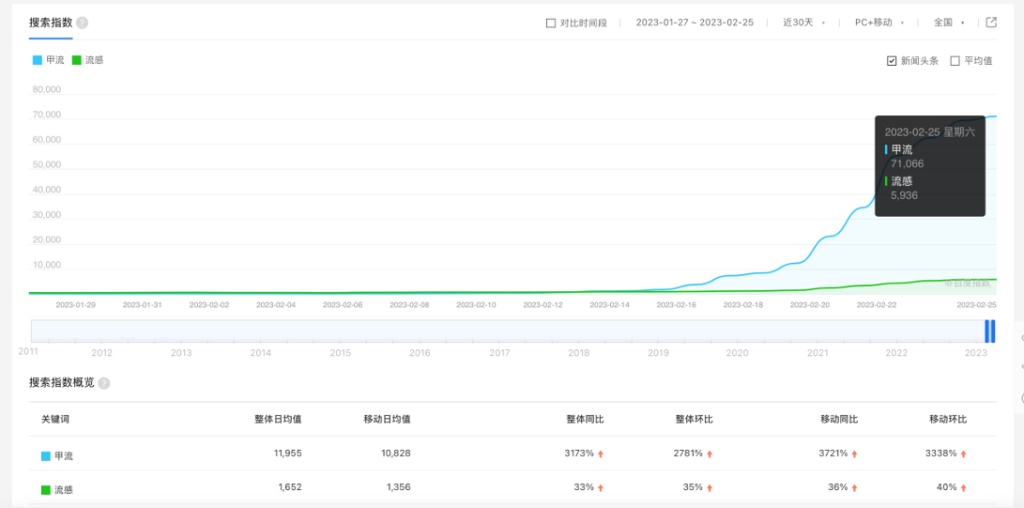
In the past 7 days, the search index of "H1N1" and "Influenza" has continued to rise. Baidu index screenshot
The typical symptom of swine flu is fever.
The probability of superposition with COVID-19 is low.
"The incubation period of swine flu is usually 1 to 3 days. The main symptoms are fever, muscle aches and headaches, and there are also some mild respiratory symptoms, such as cough, runny nose and sore throat." Wang Baozeng, director of the Department of Infectious Diseases of Beijing Tiantan Hospital affiliated to Capital Medical University, said.
Wang Baozeng told reporters that the symptoms of influenza A are similar to those of COVID-19 in the upper respiratory tract.
"However, the typical symptoms of swine flu are fever and muscle aches all over the body, which are generally not found in mild and asymptomatic patients infected with Covid-19." Wang Baozeng said, "In addition, COVID-19 may cause abnormal taste and smell, and some Covid-19 patients may have symptoms of vomiting, diarrhea and conjunctivitis, which are relatively rare in H1N1 infection."
Regarding the superposition of H1N1 and COVID-19, Wang Baozeng said that the probability of this situation is very small, and even if it occurs, it is rare for non-high-risk groups to have critical illness.
"At present, most people in China are immune to COVID-19, and the probability of being infected with COVID-19 and influenza is very low. Even if two viruses are infected at the same time, it may not necessarily become a critical illness. Whether it becomes a critical illness is related to the individual’s physique. For non-high-risk people, even if they are infected with two viruses at the same time, their strong resistance will reduce the risk of critical illness. " Wang Baozeng said, "But it is recommended that groups that have not been infected with Covid-19 continue to do a good job of protection."
Prevention of swine flu
Influenza vaccination is the first choice.
Wang Baozeng said that the most effective way to prevent swine flu is to vaccinate against influenza. "It is recommended to vaccinate before the start of the H1N1 epidemic period, usually in October. Of course, you can also get vaccinated during the epidemic. " Wang Baozeng said.
Except for influenza vaccine, other protective measures for influenza A are basically the same as those for COVID-19.
If you are infected with swine flu, don’t panic. "For groups with better physical fitness, they can be treated symptomatically, and some groups can heal themselves without treatment." Wang Baozeng said, "But for high-risk groups, such as infants, the elderly and people with basic diseases, it is still recommended to use antiviral drugs to reduce the occurrence of critical illness."
"If the patient has symptoms such as persistent high fever, dyspnea, severe vomiting and diarrhea, he must actively seek medical treatment to avoid delaying the illness." Wang Bao emphasized the tone.
Wang Baozeng reminded that you must pay attention to rest after being infected with swine flu. "No matter whether it is COVID-19 or H1N1, as long as there is a virus infection, it may cause damage to some body organs, especially the heart. Therefore, resting for 3 to 4 weeks after infection and then exercising can reduce the risk of viral myocarditis. "
Source: People’s Daily Health Client, Science and Technology Daily, Changjiang Daily.
Editor: Huang Wei
Audit: Xie Bin
Produced by: Hubei Daily Media Center
