Ying Songnian: I used to "be a blank" for administrative legislation (rule of law life)
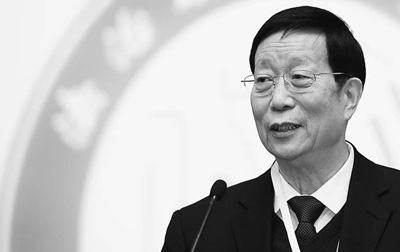
profile
Ying Songnian, a native of Ningbo, Zhejiang Province, is now a tenured professor and doctoral supervisor of China University of Political Science and Law, and honorary president of china law society Administrative Law Research Association. Deputies to the Ninth and Tenth National People’s Congress.
In the old campus of China University of Political Science and Law, located at Jimenqiao, Beijing, a small brick building with vicissitudes of life lies quietly next to the new building that has sprung up across the street. After some twists and turns, I followed the directions of passers-by, found the "Building No.3", turned the corner of the stairs on the second floor, and Professor Ying Songnian’s office was directly opposite. He had already arrived.
In 2009, Ying Songnian became a tenured professor at China University of Political Science and Law. Many articles are talking about his "firsts" in the field of administrative law. However, he himself is more willing to admit that, in fact, "I actually only studied law for one year at East China University of Political Science and Law", and his taking the road of administrative law is more like an adventure in life, or a mistake.
When I was over, I found my lifelong career.
In 1936, Ying Songnian was born in Ningbo, Zhejiang. Ningbo, which faces Shanghai across the sea, is one of the main sources of immigrants from Shanghai. Ying Songnian, who graduated from high school in 1956, also came to this city like his fellow countryman and enrolled in East China University of Political Science and Law. But fate played a joke on him the next year. Ying Songnian was labeled as a "rightist" when the anti-rightist movement began that year, and was assigned to Yili, Xinjiang, a few years later, and stayed there for 20 years.
When the country set things right and prepared to reopen political and legal colleges, Ying Songnian had already passed the age of no doubt. At that time, most of the students assigned to Xinjiang by the law department changed jobs, but there was a shortage of teachers in Northwest University of Political Science and Law. Ying Songnian, who was originally transferred to the Justice Department, was "trapped" in Xi ‘an and became a lecturer at Northwest University of Political Science and Law.
There are many courses that need to be opened everywhere in the reopened schools. Ying Songnian was appointed to open a course called "Administrative Law", although there was no such legal category in China at that time. "I have a characteristic, as long as I take the task, I will work hard; Since I am engaged in administrative law, I will do it seriously. " Ying Songnian said, in this way, he broke into the unknown field that was only vaguely known at that time.
Soon the turning point of fate will come. Soon, Ying Songnian heard in Beijing that the Ministry of Justice had organized an editorial department of law textbooks. At that time, Wang Mincan, deputy director of the Department of Laws and Regulations, was responsible for compiling a set of law textbooks, among which there might be a book on administrative law.
"No.44 Baishiqiao Road, opposite the Central University for Nationalities." Ying Songnian accurately quoted the address of the editorial department at that time. A stranger, Ying Songnian, who was over forty, knocked on the door in that building one by one that summer, until he knocked on the door of Wang Mincan. When he entered, he volunteered to participate in the compilation. Wang Mincan thought for a moment and said, "Come on." Soon, there was a phone call asking him to go to Xiamen for a meeting to talk about his ideas.
Coincidentally, the Northwest University of Political Science and Law had the richest collection of administrative law books in China at that time. Ying Songnian, who had carefully combed these materials, was amazed when he talked about Kan Kan at the Xiamen meeting. After the meeting, Ying Songnian was left in Beijing by the Ministry of Justice to compile books. Later, this book called "Summary of Administrative Law" was the first administrative law textbook compiled by New China, and it was from this that China’s administrative law started.
Seize the opportunity to suggest the introduction of litigation law
China has administrative law, but there is no administrative law. Ying Songnian recalled that in 1986, Tao Xijin, then an adviser to the NPC Law Committee, suggested that the country now had civil law, civil procedure law, criminal law and criminal procedure law, but only administrative law and administrative procedure law, so he set up an administrative legislation research group, which was attended by experts and scholars, NPC Law Committee and personnel from practical departments, to "make a blank" for the NPC’s administrative legislation.
This administrative legislation research group has recruited many experts in the field of administrative law, and many names familiar to the public today have appeared in this research group.
Ying Songnian, as the deputy leader, said that at first Tao Xijin hoped that the research group would draft the General Principles of Administrative Law first, but it was impossible to write several drafts. Just when I was at a loss, I met the Civil Procedure Law (Trial) which was about to be revised. It turned out that in this trial civil procedure law in 1982, an opening was left for the administrative case of "people’s accusation" stipulated by law, allowing litigation through civil procedures. Then, when the law is about to be amended, should we seize the opportunity to separate administrative litigation and formulate a law separately?
Ying Songnian said: "At first, I actually wanted to make the legislative steps in the field of administrative law faster, so I couldn’t wait for the legislation of administrative substantive law, so I began to draft the trial draft of the Administrative Procedure Law in 1987." After that, the research group submitted it to the NPC Law Committee to provide reference for NPC legislation. Two years later, on the basis of soliciting opinions from all walks of life, the Administrative Procedure Law was formally promulgated, which "ended the history of China’s people’s accusation for thousands of years".
But later, when Ying Songnian had more opportunities to inspect administrative law around the world, it was discovered that it was just a stopgap measure to think that the procedure first followed the entity, but it didn’t exactly fit the universal law of the development and change of the world administrative rule of law.
"This is a bit of a’ forced’ taste." Ying Songnian explained, "Without the administrative litigation law, no matter how many rights and obligations are stipulated, it will be lost because there is no’ tooth’."
On the contrary, the promulgation of the Administrative Punishment Law is more characteristic of China. Ying Songnian said, considering that it is unrealistic to legislate administrative law in one step, a split legislative idea was adopted in the drafting of substantive law in that year: the economy is developing too fast, and the departments most in need of market economy should be legislated first, and the legal acts of administrative organs that violate the law and have the greatest impact on citizens’ rights should be regulated quickly. As a result, China has taken a separate legislative path in administrative law, which is different from other countries.
"Separate legislation, there are both entities and procedures in the law. In this process, the principle of due process, the principle of legal reservation, and the hearing system have all been established. Later administrative legislation, such as the administrative licensing law, will follow this idea." Ying Songnian said.
Rethinking on Administrative Law
After talking about this past story, Ying Songnian paused, sipped his tea and continued: "In fact, many original legislative ideas in our country are worth rethinking today."
Ying Songnian is now rethinking whether the future administrative law should continue the idea of legislating separately in every field. He said that in departmental management laws, administrative procedures are generally stipulated, such as how to make administrative decisions. Although departmental legislation has made progress, it is endless to make it step by step. Often, a single law is not comprehensive, either missing this procedure or missing that rule, so can we establish a unified Administrative Procedure Law? To this end, Ying Songnian has been committed to promoting the formulation of the administrative procedure law.
In 2007, during the National People’s Congress, Ying Songnian’s delegation shared a hotel with the Hunan delegation. By chance, Ying Songnian chatted with the leaders of Hunan Province at that time about the idea of proposing an administrative procedure law. As a result, they hit it off. Then, Ying Songnian organized an expert group in Beijing, and Hunan also set up a legislative group. Experts provided the first draft, and Hunan revised and improved it according to local conditions. After going back and forth several times, in less than a year, the Hunan Provincial Administrative Procedure Regulations, which was the first in China to legislate administrative procedures separately, was completed.
Since then, other separate local administrative procedures have been introduced one after another. Ying Songnian’s own feeling is that "both theoretical and practical experience are available, and the conditions for formulating the Administrative Procedure Law are ripe."
After that, Ying Songnian handed the reporter an oral biography "Walking with France", which he had just collected and published. He pointed to the title on the cover and said with emotion: "I have been walking with France all my life."
People’s Daily (18th edition, January 20, 2016)