The deposit interest rate of small and medium-sized banks has been intensively "replenished", and there may be room for interest rate reduction in the future.

The intensive "replenishment" tide of deposit interest rates in small and medium-sized banks is coming.
According to the reporter’s incomplete statistics, as of April 8, more than ten rural commercial banks and rural banks in Guangdong and Henan have intensively announced the reduction of deposit interest rates, with the focus on medium and long-term deposits, with the reduction range of 25 BP to 80 BP.
However, unlike the pace of interest rate cuts by intensive bank deposits, the trend of bank deposits’ regularization is still continuing in the recently published annual reports of banks in 2023. Some insiders believe that although the current deposit interest rate has dropped to a low level, investors’ willingness to save in the medium and long term is still relatively strong, and the pressure on the debt side is increasing instead of decreasing. There is still room for future deposit interest rate cuts.
Intensive replenishment and reduction of small and medium-sized banks
On April 1, Chaozhou Rural Commercial Bank announced that it would adjust the listing interest rate of RMB deposits from April 1, 2024. Compared with the listing rate table updated by the bank last year, the listing rate of one-year fixed deposit decreased by 55BP to 1.55%, the listing rate of three-year fixed deposit decreased by 30BP to 2.05%, and the listing rate of five-year fixed deposit decreased by 25BP to 2.1%.
Chaozhou Rural Commercial Bank is not a case. According to the reporter’s incomplete analysis, as of April 8, more than ten city rural commercial banks and rural banks in Guangdong and Henan have intensively announced the reduction of deposit interest rates, with a drop of 25 BP to 80 BP.
The reporter noted that the downward adjustment mainly focused on medium and long-term deposits, and the decline in three-year fixed deposits was much higher than that in five years. The most typical is Henan Suiping Rural Commercial Bank. The bank’s three-year and five-year fixed deposit listing rates were 2.65% and 2.4% before the downward adjustment, and there was a phased term inversion. After this adjustment, the upside-down situation disappeared. The three-year fixed deposit listing rate is lowered by 30BP to 2.35%, and the five-year fixed deposit listing rate remains at 2.4%.
Similarly, Zhumadian Rural Commercial Bank, Taikang Rural Commercial Bank, and Panjin Branch of Fuxin Bank reduced the 3-year fixed deposit and listing interest rate, but did not adjust the 5-year fixed deposit and listing interest rate. After the adjustment, the three-year fixed deposit interest rate of the above-mentioned small and medium-sized banks has basically been below 3%.
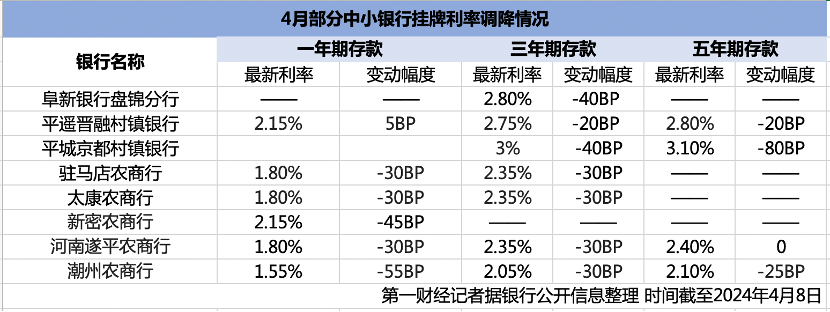
Many people in the industry believe that the current wave of interest rate cuts on small and medium-sized bank deposits is a "supplementary decline" after the previous big banks cut interest rates. The Tan Yiming team of Minsheng Securities believes that the recent reduction of deposit interest rates by a number of small and medium-sized banks is a follow-up to the "wave of interest rate cuts" by banks at the end of last year. Under the background that the net interest margin of banks continues to be under pressure, the market may usher in a new round of reduction of deposit interest rates.
In December 2023, six state-owned banks, namely Industrial and Commercial Bank of China, Agricultural Bank of China, China Construction Bank, Bank of China, Bank of Communications and Postal Savings Bank, announced that they would lower the deposit listing interest rate. The three-year fixed deposit listing interest rate of state-owned big banks broke through the integer mark of 2% and fell to 1.95%.
Small and medium-sized banks choose to follow up intensively at this node in early April, or it is related to the self-discipline mechanism of market interest rate pricing. According to the Implementation Measures for Qualified Prudential Assessment (revised in 2023) issued by the self-discipline mechanism of market interest rate pricing in April last year, if the quarterly monthly average interest rates of time deposits and certificates of deposit with key maturities of banks are lower than the desirable adjustment range in the second quarter of last year, points will be deducted on the basis of the "pricing behavior" score (total score is 100 points).
A number of banks in the announcement will also meet the requirements of the market interest rate pricing self-discipline mechanism as the reason for the adjustment of listing interest rates. For example, Yinjiang Changzheng Village Bank and Pingyao Jinrong Village Bank stated in the announcement that the listing interest rate will be adjusted according to the relevant requirements of the interest rate pricing self-discipline mechanism and the current interest rate market pricing situation.
The trend of deposit regularization still exists.
In the past year, the interest rate of bank deposits has experienced several rounds of downward adjustment. Only in June, September and December, 2023, state-owned banks updated the interest rate of RMB deposits three times, and lowered the interest rate of fixed deposits for some periods. Small and medium-sized banks also followed the rhythm to "make up for the decline" within a certain time limit.
It is worth noting that while banks keep lowering the fixed deposit interest rate, customers’ enthusiasm for medium and long-term savings has not diminished. Judging from the recent annual reports disclosed by major banks, the regularization of bank deposits is still heating up, and the pressure on the debt side is increasing instead of decreasing.
China Construction Bank pointed out in its annual report that customers have a strong willingness to save and the tendency of time deposits continues to increase. By the end of 2023, the bank’s domestic demand deposits were 12.02 trillion yuan, a decrease of 26.458 billion yuan or 0.22% from the previous year; Domestic time deposits reached 14.70 trillion yuan, an increase of 2.58 trillion yuan or 21.25% over the previous year; In 2023, ICBC’s time deposits increased by about 4.18 trillion yuan, with a growth rate of 27.6%, while demand deposits decreased by 617.111 billion yuan, with a decrease of 4.4%.
A similar situation has occurred in stock banks. According to the annual report, the scale of retail demand deposits of China Merchants Bank decreased by 7.75% year-on-year in 2023, while the scale of retail time deposits increased by 48.58%.
Another data also confirms the universality of deposit regularization to some extent. Judging from the Statement of RMB Credit Income and Expenditure of Financial Institutions in 2023 disclosed by the People’s Bank of China, the balance and proportion of time deposits in household departments and non-financial enterprises are on the rise. The proportion of time deposits in the household sector rose from 68.1% to 71.5%, while that of non-financial enterprises rose from 65.9% to 68.4%.
The trend of deposit regularization further raises the cost of bank liabilities. According to the data of Zheshang Securities Research Report, the interest payment cost ratio and deposit cost ratio of listed banks in 2023 increased by 1.3BP and 0.3BP respectively compared with the first half of 2023, and the debt cost ratio and deposit cost ratio are still on the rise.
Is there room for interest rate cuts in the future?
In fact, a number of banks also mentioned measures to ease the regularization of deposits.
"Although the deposit interest rate dropped three times in 2023, the characteristics of the deposit’s regularization and long-term trend are still quite obvious." Zhang Yi, Vice President of Bank of China, said at the 2023 annual results conference that in 2024, Bank of China will increase the pressure drop on high-cost deposits, including agreement deposits, structured deposits and certificates of deposit with a term of more than three years.
Recently, Chen Xinjian, president of Industrial Bank, said that since last year, efforts have been made to replace high-cost agreement deposits and social security deposits with low-cost deposits.
Some insiders believe that there may be room for further deposit interest rate cuts in the future, considering the trend of deposit regularization and poor net interest rate.
"There is a need to further reduce the deposit interest rate." Xiao Yu, chief fixed-income analyst of Zhongtai Securities, thinks. First, considering that the overall net interest margin of half of the listed banks and commercial banks has been lower than 1.8%, some banks must find ways to expand the net interest margin by raising the loan interest rate or lowering the deposit interest rate. At present, the latter is obviously more likely; Second, some small and medium-sized banks launched a "price war" to save money, resulting in high deposit interest rates, and the net interest margin of rural commercial banks is at a high level, and there is still room for decline.
"It is expected that deposits will cut interest rates in April." Liang Fengjie, chief banking analyst of Zheshang Securities, believes that deposit pricing mainly refers to 10-year treasury bonds and 1-year LPR, in which the yield of 10-year treasury bonds in the first quarter of 2024 decreased by 25BP; compared with the fourth quarter of 2023; Historically, the market interest rate pricing mechanism will generally hold a working meeting in the second quarter. Under the background that banks are facing greater interest spread pressure, it is not excluded to continue to guide banks to lower deposit interest rates.
Editor-in-Chief: Qin Hong
Text Editor: Dong Siyun
Author: CBN
Source of the title map: upper view of the title map