The research and development of domestic weather derivatives will be fully launched! Let me show you something about weather options first.
Source: Finance from the media
Download Sina Finance APP to see more futures information and Weibo Hui’s views.
Original title: The R&D and listing of domestic weather derivatives will be fully launched! Let me show you something about weather options first.
Source: Option Age
On June 11th, Zhengzhou Commodity Exchange recently signed a strategic cooperation framework agreement with the National Meteorological Information Center, and the two sides will comprehensively launch the compilation and application of weather indexes and the research and development and listing of weather derivatives.
As early as 1999, the Chicago Mercantile Exchange first introduced the weather futures contract, which provided a good reference for us to carry out the work related to weather derivatives. If domestic weather futures are coming, will weather options be far behind? In this article, let’s talk about weather options at home and abroad ~
Weather risk refers to the uncertainty brought by weather and climate change to people’s life and property safety, production and business activities and economic development.
According to the probability and consequences of weather risks, weather risks can be divided into three categories, namely, weather disaster risk, climate change risk and general weather risk. The first two types of weather risks can be avoided by means such as agricultural insurance and catastrophe bonds.
For general weather risks, traditional risk management strategies can’t avoid them well, while Weather Derivatives can solve this problem well.
Weather derivatives are emerging financial derivatives based on meteorological conditions such as temperature, wind speed, humidity, rainfall and snowfall in a certain area.
The understanding of weather derivatives and their functions in China is still in its infancy, and the weather derivatives market has not yet been established. With frequent weather disasters in recent years, the impact of weather risks on China’s economy has become increasingly prominent.
As the most effective means to avoid weather risks, weather derivatives are urgently needed to be implemented in China. The weather derivatives trading market has broad prospects, and the full price of weather derivatives is the primary problem in its trading.
Weather option is a kind of weather product and a derivative financial instrument based on weather futures.
In essence, the weather option is also pricing the rights and obligations separately in the field of weather finance, so that the transferee of the right can exercise its right to trade or not within the specified time, and the obligor must perform it.
1. Overview of weather derivatives
Weather derivative products
Weather derivative is a relatively new risk management tool. They allow users to buy or sell weather-related risks, such as temperature, rainfall, snowfall and other weather derivatives, which are different from traditional derivatives, because they have no original tradable underlying assets, and their targets are mainly some weather indexes. The general financial derivatives are based on stocks, bonds, foreign exchange and some commodities as the underlying assets.
General weather derivative contracts can be standardized into the following seven elements: contract type, contract term, target index, official weather station for obtaining weather data, contract execution price, contract quotation unit, option fee and maximum payment amount.
The most common weather derivatives are based on temperature changes.
Its target indexes are generally based on Heating Degxee Days and Cooling Degxee Days, and these two indexes are borrowed from the energy industry, and their main functions are to describe the deviation of temperature from the temperature baseline.
Generally speaking, the calculation method of average temperature refers to the arithmetic average of the highest temperature and the lowest temperature within 24 hours a day. In North America, the energy industry takes 18 degrees Celsius as a benchmark, because on average, when the temperature drops below 18 degrees Celsius every year, fireplaces will generally be opened.
In the weather derivatives market, we assume that when the average temperature is below 18 degrees Celsius, consumers will consume more energy to heat their rooms, while when the average temperature is above 18 degrees Celsius, consumers will consume more energy to use their air conditioners for cooling.
Although the industry standard is 18 degrees Celsius, the differences between different places are still very large. Therefore, such a benchmark is not absolute.
In the later part of the article, the baseline will be adjusted to have an impact on the pricing results.
Heating days will measure the number of days when the average temperature is lower than the standard 18 degrees Celsius, while air conditioning days will measure the number of days when the daily temperature is higher than the standard 18 degrees Celsius. For the two indices, the defined formulas are:
HDD=maxc18- daily average temperature, 0)c=min (daily average temperature 18,0) Most temperature derivatives are accumulated HD or accumulated CDD in a period. The contract term of weather derivatives is also varied, including one week, one month, or one winter or summer. To calculate the cumulative HDD or CDD in a time, you only need to accumulate the daily HDD or CDD.
Of course, in addition to HDD and CDD, there are many other indexes based on temperature that can be used as the underlying assets of weather derivatives. These various indicators provide suitable risk hedging tools for users of weather derivatives in different industries.
Some weather derivatives are traded on the basis of the so-called Critical Day Indices, which are used to calculate the number of times the temperature is higher or lower than a set boundary value in a period of time. Other weather variables also have many indicators, such as the number of days when accumulated rainfall or snowfall exceeds a certain set value.
Some common weather indexes all weather contracts are based on the actual climate observed by one or more weather stations. Most contracts are based on one weather station, and some contracts will collect data from multiple weather stations and calculate the weighted average.
All weather contracts will have a contract term, which stipulates the calculation of weather values within a limited period.
The most common ones are winter contracts from November 1st to March 31st, and summer contracts from May 1st to September 30th. April and October are often called shoulder months. However, the trading volume of weather contracts with a contract term of one week, one month or several years is increasing rapidly.
The indexes of many contracts are innovated in different degrees under the general framework, such as removing the observed values of weekends or giving double weight to special dates, etc., all of which are to meet the needs of different investors for risk management.
At present, most weather derivatives contracts are traded in the OTC market, and all the elements of the transaction are completed by private communication and consultation between the two parties. For the two parties involved in the transaction, this trading method gives the two parties the greatest flexibility. Derivatives in the OTC market are bilateral contracts, and both parties are exposed to the credit risk of the other party’s failure to perform.
The weather derivatives in OTC market are mainly call options, put options and swaps based on different weather indicators. These options are European options, that is, they can only be executed when the contract ends. For contracts in the OTC market, some key elements are the execution price, quotation unit and maximum payment amount.
There is a significant difference between these weather contracts in the OTC market and financial derivatives in other markets, that is, there is generally an upper limit on the payment of weather contracts. This artificial restriction is as common as the insurance industry’s restriction on payment.
More special option structures such as collar option, digital option, barrier option, compound option, etc. These customized products meet the diverse needs of customers.
Weather derivatives traded on exchanges are generally delivered in cash, and they need a deposit, and they are pegged to the market price every day. One party to a contract transaction always has a transaction, so there is no credit risk.
At present, there are two main exchanges trading weather products, one is Chicago Mercantile Exchange, and the other is London International Financial Futures and Options Exchange, which trades weather futures and options based on weather futures, while London International Financial Futures and Options Exchange mainly trades weather futures.
The Chicago Mercantile Exchange offers a wide range of weather derivatives and covers a wide range of areas. From the coverage area, including the United States, Canada, Europe, Asia-Pacific region, Australia and so on.
In terms of product types, there are weather derivatives based on wind, temperature, snowfall, frost and rainfall.
In terms of time limit, it is mainly one month and one quarter. The HDD futures and CDD futures traded on the Chicago Mercantile Exchange specify a certain temperature index for buyers to sell in the future.
The nominal price of each contract is $100 times the actual HDD or CDD index. The HDD or CDD call option gives the holder the right to buy HDD or CDD futures at a specific price, which is usually called the strike price.
On the other hand, HDD or CDD put options give the owner a relative right to sell HDD or CAD futures at a specific price. At the Chicago Mercantile Exchange, futures-based options are all European, which means they can only wait until the expiration date.
The rapid development of the market for raw weather products is attributed to enterprises realizing that their income and profits are no longer a gift from the weather, but can be controlled to some extent.
Because many enterprises have hedged the risks brought by interest rate and foreign exchange fluctuations, they can also protect their interests through weather derivatives in changing weather. This awareness and management of weather risks has been widely promoted in the energy industry of developed countries. The demand for weather derivatives mainly comes from the energy industry, but other industries have also begun to notice the development of this market.
According to the data given by the Chicago Mercantile Exchange, about 20% of the economic activities in the United States are directly related to the weather. In Europe and Japan, there are 1.25 trillion dollars worth of business activities and 700 billion dollars worth of business activities affected by the weather.
In recent years, frequent natural disasters in China, such as heavy snow in the south in 2008 and drought in the south in 2010, remind us of the importance of managing weather risks.
Next, we will discuss the risk hedging related to weather volatility and economic activities exposed to weather risks.
2. Risk hedging related to weather volatility and economic activities
Weather risk comes from weather changes, such as temperature, rainfall and snowfall. Nowadays, many weather derivatives are traded based on temperature. Table 2-2 shows the temperature fluctuations of five representative cities in the United States.
The temperatures in these five cities are all available for trading on the Chicago Mercantile Exchange. These five cities include:
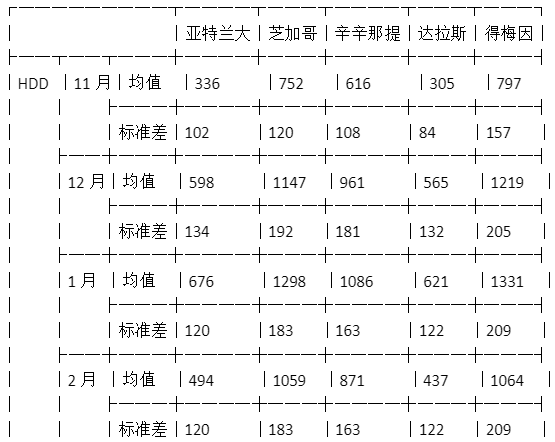
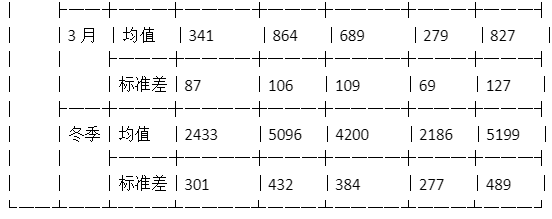
Table 2-2 Temperature Fluctuations in Five Cities in the United States: Monthly HDD and Quarterly HDD
Weather exposure is defined as dR/dW, which is expressed as the sensitivity of income to weather. There are many industries affected by the weather, such as agriculture, tourism, clothing, beverage construction, energy, entertainment, logistics and other industries.
Table 2-3 briefly describes the relationship between some industries and weather changes, and how weather changes affect the operation of industries.
Table 2-3 Relationship between Weather Risk and Some Industries
Weather risk is generally a quantitative risk. For buyers and sellers of many commodities, the change of quantity can adversely affect the change of price. Price risk management tools can be used on many commodities. However, these tools have certain restrictions on hedging quantitative risks.
If the weather risk can’t be completely eliminated, then weather derivatives, with their unique advantages, become one of the best tools to manage the quantitative risk, which can guarantee the stability of income.
3. Overview of weather derivatives market
The weather derivatives market is rooted in the liberalization reform of the energy industry in the United States. The change of weather conditions is always considered as the biggest factor affecting energy consumption.
However, these unpredictable climate changes were regulated and managed in a monopolistic environment before. With the development of liberalization, more market participants have joined in the process of producing, selling and transporting energy.
Therefore, the weather, as one of the important risks, needs to be faced and solved by the participants in the market. Peugeot, which was born as a weather derivative market, is generally regarded as Koch Industries and Enron Corporation of the United States. They announced that they signed a contract based on the number of heating days in Milwaukee from 1997 to 1998.
This first transaction was completed in the over-the-counter market. The purpose of the transaction is to protect the losses caused by the special circumstances that the temperature in winter exceeds the average temperature in previous years and the temperature in summer is lower than the average temperature in previous years.
In the early days, market participants used weather derivatives as a hedge against the exposure of their energy assets to weather changes, and also as a risk management tool for other energy commodities.
The considerable income from investing in weather risk-related products has attracted more capital, including banks, insurance companies and mutual funds. They are all looking for ways to diversify their portfolios and improve their returns. At the same time, the demand for weather risk management products has expanded from the energy industry to other industries. The company’s risk control manager began to look at the risks that could not be accepted by insurance companies from a new perspective.
In order to cope with these increasing demands, the scope of weather derivatives continues to expand with the innovation of the market.
At present, the trading products of weather derivatives have covered almost all weather variables, ranging from a week to several years, and the payment amount ranges from several thousand dollars to hundreds of millions of dollars. The prosperity and development of the weather derivatives market is not only reflected in the increasing types of risks that can be hedged, but also more enterprises from all over the world trade in this market.
Weather derivatives are also developing rapidly all over the world. Britain, Australia, France, Germany, Norway, Japan and so on have completed the local weather products transactions.
Although most of the transactions are still completed in the OTC market, the standardized transactions completed in the Chicago Mercantile Exchange are providing a model for other countries in the world to improve their markets. In these markets, the increase in trading volume has increased the liquidity of weather derivatives and the function of price discovery.
At the beginning of the birth of the weather risk management market, since 1997, the weather product market has gradually become an active risk management department. According to the estimation of WRMA, in 2011, the transaction volume of weather derivatives market in the United States has reached $12 billion. The weather-related economic activities have already accounted for more than B096 of the total US economy.
At this time, the total transaction volume in the European market is 700 million US dollars, while the total transaction volume in the Asian market is 150 million US dollars. The size of the Australian market is relatively small compared with other markets, only about $30 million.
Among them, the trading volume of weather products based on temperature is the largest, basically, the number and types of participants who can account for more than 9596 of the total trading volume of weather products are expanding. A variety of market participants provide weather risk management products, including energy trading companies, hedge funds, insurance companies, investment banks and commercial banks. Each market has its own product assembly line and pricing model.
Financial investors will take advantage of the low correlation between the income of weather derivatives and the income of other financial instruments to build a new portfolio. Weather derivatives may reduce risk and increase the return of portfolio. Like insurance products, they can become new assets in investors’ portfolios.
Because the weather derivative market was originally born to meet the needs of public utilities and energy trading companies. Companies and institutions have close ties with energy trading companies, so emerging weather products can also help public utilities manage the risk exposure of natural gas prices.
The energy trading company, with rich experience in weather risk management, is the original innovator in the weather derivatives market, and has always been the main participant in the market.
Energy trading companies provide many weather derivatives for the over-the-counter market. Users of weather derivatives can hedge the weather risks in specific locations. This kind of protection is very close to the risk and the trigger range is very wide.
In many ways, the weather market represents a new field that is not covered by the insurance market and the financial market. The insurance and reinsurance industry is the main participant in this market year, although the insurance industry used to provide insurance for the risks caused by huge disasters in the past, rather than the risks caused by seasonal weather changes.
However, the insurance industry is still actively participating in the weather derivatives market for two main reasons.
First of all, weather derivatives have many similarities with traditional insurance products. Secondly, at the operational level, some knowledge preparations required to participate in the weather derivatives market and the insurance market overlap in many aspects, so it is very easy for employees in the insurance industry to participate.
Therefore, after the establishment of weather derivatives market, insurance companies often provide customers with two different forms of services, the form of insurance and the form of derivatives.
Commercial banks and investment banks have always been the most active financial institutions in the financial market, and they are also active participants in the weather derivatives market. Some institutions only provide some advice to customers, while others participate in derivatives trading themselves and bear certain risks. Many banks have rich experience and rich customer base in the transaction of financial products. They can dig out customers who are interested in managing weather risks from existing customers.
4. Development of weather derivatives in China.
According to a data released by Weather Bill Company in the United States, the economic value of China affected by weather accounts for about 45% of the total ODP in China, and half of our population lives in areas with certain weather risks. The annual economic losses caused by weather risks can reach more than 200 billion yuan.
Therefore, the demand of weather derivatives market in China is huge. However, weather derivatives have not yet been introduced in commodity futures trading in various parts of China. From 2002, Dalian Commodity Futures Exchange began to study weather derivatives in all aspects, including theoretical study and actual market inspection and testing.
In order to obtain the first-hand data, the weather products team of Dalian Commodity Futures Exchange specially organized personnel to go to the markets of weather derivatives developed countries such as the United States and Japan to inspect the development of weather derivatives abroad.
In order to get better weather data, Dalian Commodity Futures Exchange signed a long-term cooperation agreement with China Meteorological Bureau. For this purpose, Dalian Commodity Futures Exchange selected more than 80 large and medium-sized cities in China or representative cities with climate as research objects, and studied the weather from many angles, including the changes of electricity and natural gas consumption in different agricultural production areas and different population and density.
Moreover, Dalian Commodity Futures Exchange has conducted in-depth research on the precipitation, temperature change characteristics and catastrophic natural disasters in these 80 cities, and combined with the meteorological data released by China Meteorological Observatory for nearly 30 years, providing a reliable basis for the design of weather futures contracts, and initially designed weather derivative contracts.
In 2006, Dalian Commodity Futures Exchange began to cooperate with Tokyo Futures Exchange to jointly study the development of weather derivatives and the operation of the market from many aspects.
For many weather products, Dalian Commodity Futures Exchange will focus on the contract of weather products based on temperature.
In November 2012, the Hong Kong SAR Government and the Hong Kong Stock Exchange also began to investigate the feasibility of establishing a market for raw weather products, and combined with the climate characteristics of various places, studied weather derivatives based on indexes such as temperature, precipitation and frost, and prepared to launch related products in due course.
China’s agricultural production is still in a relatively backward stage, but it is very meaningful to explore weather derivatives and use them to avoid risks.
The more kinds of weather derivatives, the more abundant weather risk management tools can be provided for agricultural producers and operators. After the weather derivatives market is established, agricultural insurance companies can transfer weather risks through marketization. In this way, agricultural insurance companies can avoid their own risks through marketization without relying entirely on state finance.
China has been a big agricultural country since ancient times. Due to the abnormal weather changes in China, there are great weather risks in agricultural production. In order to maintain a relatively stable growth rate of farmers’ income, we should not only avoid the risks caused by price fluctuations through agricultural futures, but also actively study weather derivatives, so as to avoid the risks in crop yield when encountering adverse weather conditions.
5. Overview of weather derivatives in developing countries
In developing countries, weather risk management is becoming more and more important. Compared with developed countries, developing countries are more vulnerable to natural disasters. According to the research results of Varangis(2001), the economic losses caused by natural disasters in developing countries are 20 times that of developed countries.
The weather has a positive or negative impact on many economic activities. Energy, agriculture and medicine are typical industries that are very sensitive to the weather. The cost and income of these industries are directly linked to the weather conditions. In particular, some extreme weather conditions, such as drought or flood, extremely high temperature or extremely low temperature, storms and so on, have a very serious impact on individual farmers and a large number of people who rely on agriculture.
In recent years, the international community has realized that human beings are vulnerable to the weather. Although there is no way to control the weather now, we have new ways to weaken the impact of the weather on the economy.
Although weather derivatives are developing rapidly in the energy industry in developed countries and have many applications in agriculture, they are limited in developing countries, and agriculture is very important to many developing countries.
In fact, weather derivatives can help developing countries solve two basic problems, one is to provide more ways to solve catastrophic weather risks, and the other is to improve the development of new personal insurance products that are highly dependent on weather.
Varangis(2001) has summarized some key conditions for developing weather derivatives in developing countries.
(1) There are reliable and verifiable weather forms. Generally speaking, for a certain area to become the target of weather derivatives, there must be at least 30-40 years of traceable weather data in this area. More importantly, the cost and quality of obtaining data must be taken into account.
(2) Certified weather stations must be established to ensure accurate interpretation of weather events. Another way to obtain accurate data is to compare the data of nearby weather stations or weather data obtained by meteorological satellites. Meteorological satellites can be used to assist in estimating rainfall, wind, temperature, etc.
Then, there is also a problem with the data released by meteorological satellites, that is, there may be a possibility that it cannot be connected with the traditional measurement methods before. Rainfall types vary from place to place. For example, in China, rainfall distribution is characterized by more in the southeast and less in the northwest, because the eastern coast is more susceptible to monsoon than the inland in summer.
Therefore, the types of weather products contracts based on Hebei Meteorological Station are quite different from those of weather derivatives based on Sichuan Meteorological Station. In addition, it is very important to determine the correlation of rainfall, and low correlation means high basic risk of rainfall.
Of course, it is more important to average the measurement results over a longer period of time and in a larger area. Low spatial correlation may make it difficult for individual farmers to buy weather derivatives, but it will be much less for institutional investors and some energy companies, because they often trade weather products across regions.
Whether the basic risk will exceed the benefits brought by weather insurance is an empirical question, which needs to be judged according to the spatial correlation of rainfall.
In the face of extreme weather events, it is difficult to find a counterparty with opposite risk exposure, while the weather product market can find a counterparty in a low-cost way. The actuarial stability of insurance companies is calculated based on the probability of weather cycle changes.
Whenever a weather event is confirmed, it is necessary to adjust the cost of insurance, although there is a certain time lag between changing the policy cost and selling insurance products. However, this change only happens when the weather form changes, not when the weather form continues to run along the past form.
In many developing countries, weather derivatives are not used as an insurance tool. After careful investigation and study, the relevant regulations can be modified to allow the development of weather derivatives and insurance related to weather derivatives.
Generally speaking, the weather market provides new conditions and opportunities for developing countries to manage catastrophic and non-catastrophic risks. The ruling authorities can also make more use of this market to design effective weather disaster relief programs.
6. Development opportunities and paths of weather derivatives in China.
China is a vast country, with such a huge geographical span that the climate has become very large. From south to north, from inland to coastal areas, China has a variety of temperature and rainfall areas. The temperature is influenced by different latitudes and monsoon activities, and the change is also very complicated and changeable.
Generally speaking, in winter, the average temperature in the north of Qinling Zhunhe Line will be below 0 degrees Celsius, while in the south it will be above 0 degrees Celsius. Mohe County in Heilongjiang Province is the coldest area in China, while Hainan Province is the hottest area in China.
In summer, the average temperature in most parts of the country is above 20 degrees Celsius, except the Qinghai-Tibet Plateau and some other mountainous areas. Because it is very hot in summer, Chongqing, Wuhan and Nanjing are called the three stoves in China. The rainfall in China is regular every year. Basically, it has always been more in the southeast coast and less in the northwest inland. At the same time, the southeast coast is more vulnerable to monsoon weather.
Often, due to too much or too little rainfall, disasters such as floods and droughts often occur in China.
Every summer, the southeast monsoon from the western Pacific meets the southwest monsoon from the Indian Ocean, causing a lot of rainfall in China. East China often experiences weather changes. At the same time, northwest China belongs to non-monsoon areas, so the weather changes are relatively less.
China is also a big agricultural country, and the "power of nature" has a great influence on individual farmers and a large number of people who depend on agriculture. China has always had a weather tradition of "waterlogging in the south and early in the north", which has affected the lives of hundreds of millions of people. Although some studies show that this situation is changing, such as the heavy rain in Beijing in 2012 and the early morning in southwest China in 2010.
However, climate disasters still occur frequently in China. For example, the heavy rain in Beijing in 2012 resulted in a disaster-stricken area of 14,000 square kilometers and a disaster-affected area of 16,000 square kilometers. Nearly two million people in the city were affected, including one million in Fangshan District.
Many bridges, roads and water conservancy projects in the city were damaged, many houses in the city collapsed, and hundreds of cars suffered serious losses. In 2010, Yunnan, Guizhou, Sichuan, Chongqing and other five southwestern provinces and cities suffered a hundred years of early morning, which caused more than 60 million people to be affected, and more than 10 million people could not get drinking water in time. The economic losses directly caused by the drought reached more than 20 billion yuan.
Undoubtedly, the change of weather has a great influence on agricultural production in China. Studies have shown that major crops such as wheat, rice and corn have been greatly reduced in the second half of the 21st century, and the reduction rate can reach 37%. Crops will be seriously affected by weather changes in the next 20-5 years.
If no measures are taken to deal with weather disasters, it will have an impact on the quality of crops and the long-term sustainable and stable economic development. Weather risk management can provide a variety of weather products for agricultural producers, so as to transfer weather risks.
After trial and error, it is gradually popularized, and then it is gradually adjusted and improved according to the actual situation. If it is different, it is abandoned. This method is often used in our economic system reform, just like the stock market in the early 1990 s.
We can’t wait until the financial environment, legal environment and technical conditions are all mature before developing the weather derivatives market. Just as it is impossible to wait until the joint-stock companies are all standardized, the management level of the regulatory authorities has all improved to a certain level, and investors have all received perfect risk education before exhibiting the stock market, we should also do more detailed and scientific experiments and explorations on the development of the weather derivatives market.
In this way, our weather derivatives market can gradually mature in constant exploration.
As foreign countries have developed weather derivatives for many years, we are in a backward position, so we can’t develop weather derivatives too much, and of course, we can’t do it at once.
In order to reduce risks and improve the use value of weather derivatives, we can choose some pilot cities, whose economic activities are greatly affected by weather risks and their financial industries are relatively developed. Through a small-scale pilot, we will constantly standardize the trading mechanism and supervision system, improve the market organization system, and then promote it to more cities after having certain successful experience.
When developing weather derivatives, the choice of the overall path is very important. China should proceed from the actual needs, follow the order from low to high, from simple to complex, from low risk to high risk, and gradually establish a perfect trading type and system of weather derivatives.
With regard to the choice of weather derivatives, we can imitate the Chicago Mercantile Exchange, first introduce weather futures, which are relatively basic derivatives, and then introduce more complex weather swaps and weather options based on weather futures.
In the selection of weather derivatives, we can choose the weather derivatives based on temperature index, which are the most mature in foreign countries and the most in demand in China, as the pilot, and other kinds of weather derivatives can be launched one after another after the weather derivatives of temperature index are more mature.
In the choice of trading methods, we can choose to develop on-site trading first, so that the risks are relatively controllable, and then we can extend it to the OTC market when the market is mature.
7. Possible participants in China weather derivatives market.
Weather risk will affect the income and profit of energy production industry, food and beverage industry, tourism industry and agriculture. In recent years, many enterprises in air conditioning, electric power, insurance, construction and other industries have shown their great interest in specialized and customized meteorological atmosphere.
As early as 1997, Haier Air Conditioning Beijing Sales Company purchased relevant weather forecast materials from China Meteorological Bureau. In 2003, China, Electrolux signed a cooperation agreement with the Meteorological Bureau, from which it can obtain professional weather services.
In 2011, China Three Gorges Group cooperated with China Meteorological Bureau to provide more professional meteorological services for the development of wind power in China.
Now, more and more enterprises begin to use this type of service, and most of them are large state-owned enterprises and the world’s leading companies, because there is a strong demand for weather information in China.
More and more enterprises, in different industries, have realized that weather is a heavy factor affecting their income, so it is very possible and necessary to develop the market for raw weather products.
Reporting/feedback